Ask any urologist and they’ll tell you the same thing, patients wait too long and that is where real problem starts.
There’s a specific discomfort that comes with urological symptoms. People don’t talk about them. They don’t Google them at normal hours. They manage, adjust, and quietly hope it sorts itself out. And then six months later they’re still managing it, except now it’s gotten worse.
The fear of surgery is a big part of it. “Urology surgery” sits in people’s heads as this major, life-disrupting event. Long hospital stays, difficult recovery or weeks off work.
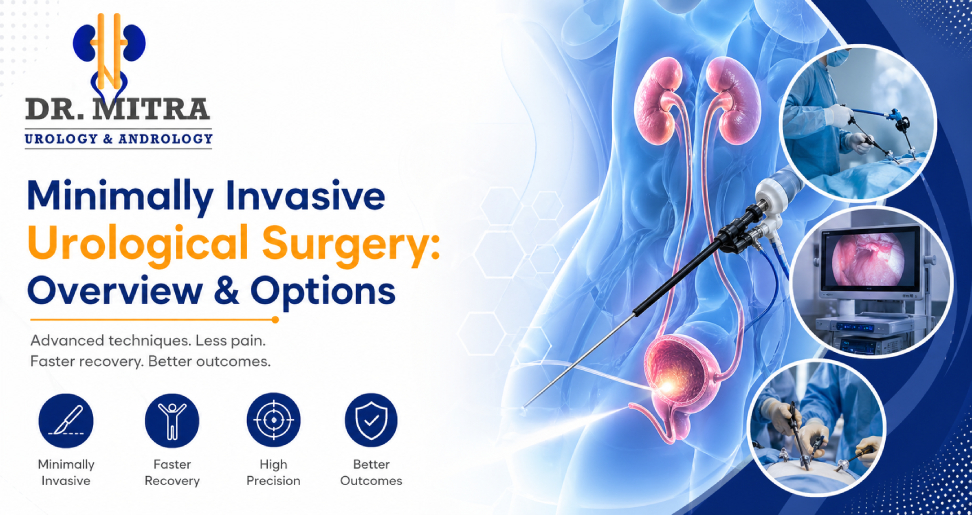
But here’s what’s happening in most urological cases today, the procedure is done through incisions smaller than a centimetre, sometimes through no incision at all. Patients go home the next morning. Some the same evening and recovery is days, not weeks.
The version of urology surgery most people are afraid of. It’s largely not what happens anymore.
Why This Approach Actually Works Better
Less cutting doesn’t mean less effective. For most urological conditions, minimally invasive surgery produces outcomes that match and, in some cases, improve ontraditional open surgery.
The body recovers faster when there’s less trauma to surrounding tissue. Infection risk drops. Pain after the procedure is genuinely manageable. And because hospital stays are shorter, patients get back to their lives and back to normal function much sooner.
It’s not a compromise. It’s just a better way to do it in most cases.
Kidney Stones
This is where most people first encounter urology surgery, and it’s also where minimally invasive techniques are most established.
Ureteroscopy, a thin flexible scope guided through the urinary tract, breaks up and removes stones without a single external cut. You go under anaesthesia, the stone gets dealt with, you go home. Often the same day.
Larger stones, or ones sitting in awkward positions, get handled through PCNL, a small puncture in the back, roughly the size of a pen tip. One hole, no open surgery. Most patients are surprised by how little the recovery involves.
Prostate Problems in Men
Urology surgery for men dealing with an enlarged prostate, BPH has changed substantially. Laser prostatectomy has largely replaced older techniques that required longer hospital stays and harder recoveries.
The procedure is done through the urethra. No cuts at all. Men who’ve been managing symptoms with medication for years or putting off doing anything because they assumed surgery would be a big deal, often come out saying it was nothing like what they expected.
The bigger issue is awareness. A lot of men are still operating on assumptions from a decade ago. The options are better now.
Urological Conditions in Women
Stress incontinence, leaking during a cough, a laugh, exercise affects far more women than actually come in for it. Same with pelvic organ prolapse. Both get managed quietly for years before anyone does anything.
Urology surgery for female patients in this area is done through tiny incisions or robotically. Sling procedures for incontinence. Laparoscopic repair for prolapse. Recovery is typically under two weeks. Most women describe it as much easier than they anticipated.
And the alternative is just living with it, doesn’t improve over time.
Bladder Conditions
Bladder tumours found on cystoscopy can often be removed in the same session, through the urethra, without any external incision whatsoever. That’s the transurethral approach with no cutting, no external marks.
More complex cases involving the kidneys, adrenal glands, or bladder reconstruction are handled laparoscopically. The incisions are small. The results are the same.
What Happens at the First Appointment
Ultrasound, CT scan if needed, flow studies, cystoscopy where relevant. The aim is to understand exactly what’s happening before any decision gets made.
Some patients need surgery. Some don’t at least not immediately. Some need something else entirely first. That depends on the case, not a standard checklist.
What most patients leave with is clarity. Which is usually what they needed in the first place.
Before the Procedure and After
Preparation is simple, fast beforehand. Anaesthesia, a general or spinal depending on what’s being done. The procedure goes through ports or natural openings. Most patients are mobile by the evening.
At home, it’s a few days of soreness, keeping things clean, normal precautions. Follow-up in a week or two.
The drawn-out recovery people dread. Rare. Not impossible, but not the norm with these approaches.
A Few Practical Things
- Bring any scans or test results from before — avoids repeating groundwork unnecessarily
- Ask whether minimally invasive applies to your specific case. For most urological conditions, it does
- Ask how often the surgeon performs that exact procedure — general surgical experience isn’t the same thing
- Most people overestimate recovery time. Don’t let that be the reason you keep delaying
- Symptoms affecting sleep or daily routine — that’s when waiting stops making sense
Frequently Asked Questions ( FAQs) :-
Ans :- For most urological conditions, yes and outcomes are at least as good as open surgery. Less operative trauma, faster healing, fewer complications. It’s not a newer or less proven approach at this point.
Ans :- Three to five days before most people are back to light activity. Two to three weeks for full recovery in most cases. Surgical extractions and complex reconstructions take a bit longer, but still far shorter than open procedures.
Ans :- Yes, fully. Incontinence, prolapse, kidney stones, bladder conditions. Urology isn’t just male-focused, and the minimally invasive options apply right across it.
Ans :- Almost certainly not. Earlier is easier, but most conditions are still very manageable. The first step is a proper assessment to understand what you’re actually dealing with.
Final Thoughts
Urological problems get put off more consistently than almost anything else. The subject feels private, the word surgery feels heavy, and the hope that it’ll resolve on its own is easier than making an appointment.
But the longer it goes, the fewer easy options there tend to be.
Dr. Nilanjan Mitra manages the full range, kidney stones, prostate, bladder, and female pelvic conditions using minimally invasive approaches wherever the case allows. If it’s been on your mind, a first consultation is a low-commitment way to find out what’s going on.
Have A Look :-