The question we get asked most of time “Is this really necessary? And if it is, why robotic?”
Men come to us after a prostate cancer diagnosis carrying two things. Fear and questions. The questions are usually about what the surgery actually involves, how long it takes, what recovery looks like, and what life looks like after. The fear is usually about all of it at once.
We explain robotic radical prostatectomy step by step because men who understand what’s happening go into surgery differently. They recover differently too and it is not something we’re guessing at. We’ve seen it consistently across our patients.
Is Robotic Prostatectomy a Major Surgery?
Yes. We are clear with patients about this.
Robotic radical prostatectomy is the surgical removal of the entire prostate gland. In most cases we also remove the seminal vesicles and nearby tissue. Depending on the staging, we may take some lymph nodes too.
It is major surgery. What makes it different from traditional open prostatectomy is how we perform it. Open surgery requires a large incision in the lower abdomen. Robotic surgery uses four to five small incisions, each less than a centimetre wide. We operate through those incisions using a robotic system that translates our hand movements into precise instrument movements inside the body.
The robotic system gives us a magnified three-dimensional view of the surgical field. It filters out hand tremor. It allows a range of motion that human hands inside an open incision cannot match. For delicate structures around the prostate, particularly the nerves involved in erectile function and the sphincter involved in continence, this precision matters a great deal.
Major surgery with different experience, that distinction matters.
How Painful Is Robotic Prostate Surgery?
Less than most men expect and most important much less than open surgery.
We tell patients to expect discomfort, not the pain they’re imagining. The small incisions cause far less trauma to surrounding muscle and tissue than open surgery does. Post-operative pain scores in robotic prostatectomy patients are consistently lower than in open surgery patients.
Most of our patients manage post-operative discomfort with standard oral pain medication. They are mobile on the day of surgery. They walk around the ward the same evening. That would not happen after open surgery.
Some soreness around the incision sites for the first week. Some discomfort where the catheter sits but manageable. Not the experience people fear when they hear the word surgery.
Step by Step: What We Do in the Operating Theatre
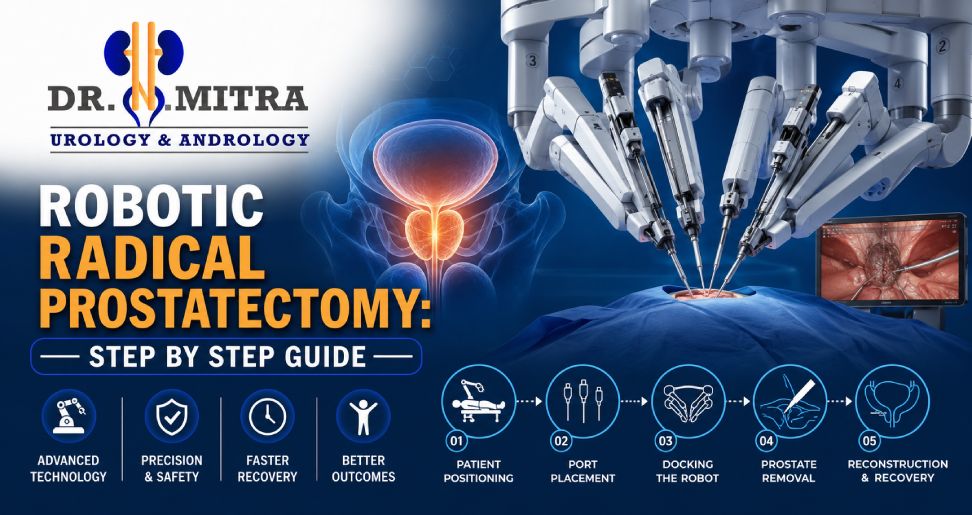
We position the patient and administer general anaesthesia. The surgical team sets up the robotic system.
We make four to five small incisions in the lower abdomen and insert the robotic ports and camera. Carbon dioxide is used to create space inside the abdomen so we can see and work clearly.
We identify and carefully separate the prostate from the bladder, urethra, and surrounding structures. The nerves responsible for erectile function run directly alongside the prostate. Where the cancer location and staging allow, we preserve these nerves. This is nerve-sparing technique and we discuss specifically whether it’s possible for each patient before the day.
We remove the prostate and the seminal vesicles. The urethra is then reconnected to the bladder. A catheter is placed and the incisions are closed.
Total time in theatre is two to three hours for most cases. Some complex cases take longer and we set expectations for this before surgery.
What Recovery Looks Like
Hospital stay is one to two nights for most patients. We send people home earlier than they often expect.
The catheter stays in place for one to two weeks while the bladder-to-urethra connection heals. We explain catheter management clearly before discharge. Most patients adapt within a day or two.
Week one is rest. Week two, movement increases. Most patients are driving by week three to four and back to desk work at six weeks.
We have an honest conversation with every patient before surgery about continence and erectile function recovery. Both take time, may be months or weeks. Men who go in knowing this manage the recovery better than men who are surprised by it.
What Is Life Expectancy After Robotic Prostate Surgery?
For localised prostate cancer treated at the right stage, the long-term outcomes are strong. Many of our patients with low and intermediate-risk disease live out a completely normal lifespan.
We monitor PSA levels after surgery. Undetectable PSA is what we look for. Rising PSA can mean recurrence, and we want to catch that early. Follow-up is not a formality. It is how we keep outcomes strong over years.
The specific outlook depends on the cancer grade and staging, whether surgical margins were clear, and how PSA behaves afterward. We discuss this in detail individually with every patient.
What We Ask Every Patient to Do Before Surgery
Begin pelvic floor exercises at least four weeks before the surgery date. Not after. Before. The evidence for better continence recovery when patients have done pre-operative pelvic floor work is clear. We see it in our own patients.
Stop smoking before the procedure. It affects healing. It affects an aesthetic response. And stopping makes a real difference.
Ask us directly whether nerve-sparing is planned for your case. The answer depends on tumour location. It affects erectile recovery. Know before the day.
What Our Patients Ask
Ans :- Yes. Major in the clinical sense. The experience is different from open surgery. Smaller incisions, less blood loss, faster return home, lower post-operative pain. The cancer surgery is the same. The recovery is not.
Ans :- Much less than men expect. Discomfort for the first week, mostly manageable with oral medication. Our patients are mobile the same day. Open surgery patients are not.
Ans :- For localised disease at the right stage, fifteen-year survival rates are strong. We monitor PSA after surgery and act early if anything changes.
What Makes the Difference in Outcomes
Men who go in prepared do better. Not because their surgery is simpler. Because they come in knowing what to expect, do the pelvic floor work beforehand, keep their follow-up appointments, and act early when something needs attention.
That preparation is part of what we provide at every consultation.
Dr. Nilanjan Mitra performs robotic radical prostatectomy with nerve-sparing technique where staging allows and follows every patient through the full recovery period with regular PSA monitoring and post-operative support. If a prostate cancer diagnosis has been made and surgery is being considered that consultation is where the right plan gets built.