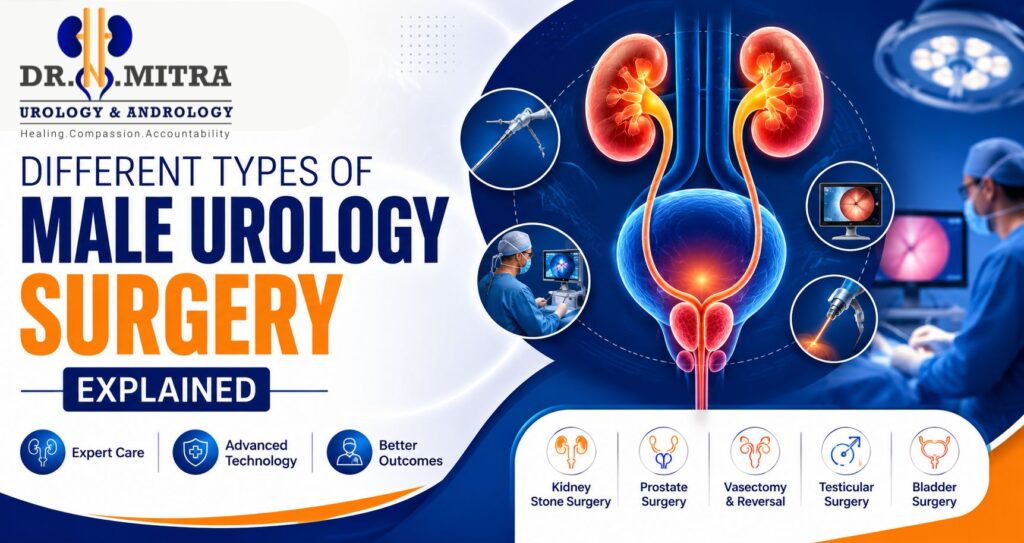
The conversation most men put off for a year are Urological issues. These problems are quiet in the beginning. A change in the stream. Getting up twice a night instead of once. Some discomfort that comes and goes without being bad enough to act on.
And so it waits and sometime months or more than a year in a lot of the cases we see at N Mitra. Men manage around the symptom rather than finding out what’s causing it.
Almost every time the diagnosis is treatable. Often straightforwardly so. The longer the wait, the more entrenched the problem usually is, but rarely does waiting make something genuinely unfixable. What it does is delay relief that could have come earlier.
Modern urological surgery covers a wide range and most of it is far less disruptive than men expect when they finally walk through the door.
Prostate
More male urological surgery happens around the prostate than anywhere else.
BPH, benign prostatic hyperplasia, is a non-cancerous enlargement of the prostate that affects a significant proportion of men over fifty. The prostate wraps around the urethra just below the bladder. When it enlarges, it squeezes the urethra. Urine flow weakens. The bladder starts working harder to push through a tighter opening. Eventually it can’t fully empty.
Common symptoms include:
- Frequent urination
- Getting up multiple times at night
- A weak stream that takes effort
These are the symptoms men describe and most of them assume this is just aging. It’s not just aging. It’s a prostate that’s changed and is blocking things.
Surgery for BPH goes through the urethra. No external incision. TURP removes obstructing tissue with an electrical loop. HoLEP does the same with a laser and often with less bleeding and faster return to normal urination. We use both depending on what the clinical picture shows.
Prostate cancer surgery is different. Radical prostatectomy removes the entire prostate. We perform this laparoscopically, with robotic assistance in most cases, through small incisions that allow the precision needed near the nerves responsible for continence and erectile function. Recovery is faster than open surgery. The post-operative conversation about continence and erectile function recovery is one we have before surgery, not after.
Kidney Stones
Kidney stones are one of the most painful things we see patients come in with. The pain of a stone passing through the ureter is sudden, severe, and tends to send people to emergency departments rather than planned appointments.
Most stones are now managed without open surgery and without any incision at all.
Ureteroscopy uses a flexible instrument passed through the urethra and up into the ureter or kidney. The stone gets broken up with laser energy and the fragments are removed. Patients are often back to normal within a day or two.
Larger or more complex stones, particularly those sitting in the kidney itself, require PCNL, percutaneous nephrolithotomy. A single small puncture in the back. One entry point. The stone is accessed directly and cleared. Still a very different proposition from what kidney surgery used to look like thirty years ago.
Bladder
Cystoscopy is both diagnostic and sometimes therapeutic. A camera passes through the urethra into the bladder. If a tumour is found, it can often be removed in the same procedure. TURBT, transurethral resection of bladder tumour, does this without any external incision under general or spinal anaesthesia.
More complex bladder conditions occasionally require more extensive surgery. These cases are planned carefully after staging tells us exactly what we’re dealing with.
Scrotal and Testicular
Hydrocele is a build-up of fluid around the testicle. It’s common. It’s usually painless. But it can become large enough to cause discomfort and embarrassment. Surgical correction is a day procedure with a short recovery.
Varicocele is an enlargement of the veins in the scrotum. Causes a dull ache in many men and is one of the most common correctable causes of male infertility. Microsurgical varicocelectomy addresses this effectively.
Testicular torsion is the emergency. The testicle twists on its blood supply. Sudden severe scrotal pain, often accompanied by nausea. If this is what’s happening, the journey is to the emergency department, not to a planned appointment. The window for saving the testicle is measured in hours. This one cannot wait.
Urology Surgery for Female Patients
Urology is not a male-only specialty. The kidneys, ureters, and bladder are present in everyone and all of them can develop problems requiring surgery.
Urology surgery for female patients at N Mitra includes kidney stone management using the same minimally invasive techniques used in men. Bladder tumour treatment. Ureteral reconstruction where needed.
Urology surgery for female patients also encompasses pelvic floor procedures. Sling surgery for stress urinary incontinence, which affects a very large number of women and is severely under-treated. Laparoscopic or robotic prolapse repair. These procedures are highly effective and the recovery is much more manageable than most women expect when they finally address these issues.
Before Surgery: What Actually Matters
Get a proper investigation before any procedure is agreed to. Imaging, urodynamic studies, cystoscopy where indicated. Symptoms point in a direction. Investigations confirm what’s there.
Ask specifically about the surgical approach. Minimally invasive versus open matters for recovery, pain, and how quickly normal activity returns.
Know the recovery timeline before the surgery date. Not a vague estimate. A specific expectation of what the first week, the first month, and the return to full activity looks like.
What We Hear at Consultations
What are the most common types of male urology surgery? Prostate surgery for BPH or cancer, kidney stone removal, bladder tumour treatment, and scrotal procedures. Each has its own approach and its own recovery.
Is urology surgery always minimally invasive? Not always. But in most cases today, yes. The goal is the least invasive approach that achieves the outcome needed.
What does urology surgery for female patients involve? The same kidney and bladder surgery performed in men, plus incontinence and prolapse procedures specific to female anatomy.
The Pattern We See Consistently
Men who come in having delayed the conversation for a year or two. Treatment that works. And then, almost without exception, the same comment. They wish they’d come in sooner.
N Mitra provides the full range of male and female urological surgery using minimally invasive techniques wherever the case allows, with thorough assessment before and follow-up after every procedure. If a urological concern has been sitting unaddressed, that consultation is the right next step.
Read More: