We’ve had this conversation hundreds of times and it almost always starts the same way.
A man comes in after a prostate diagnosis, sits down, and hasn’t slept properly in a week. He has questions but doesn’t know which ones to ask first. He’s read things online that have made the fear worse, not better.
The first thing we do is put the phone away and actually explain what’s happening. Because men who understand what prostate surgery involves go into it differently. They prepare better. They recover faster. And they stop losing sleep over things that aren’t actually as bad as the internet suggests.
Prostate Surgery Is Not One Thing
This is the part that confuses most patients when they first come to us.
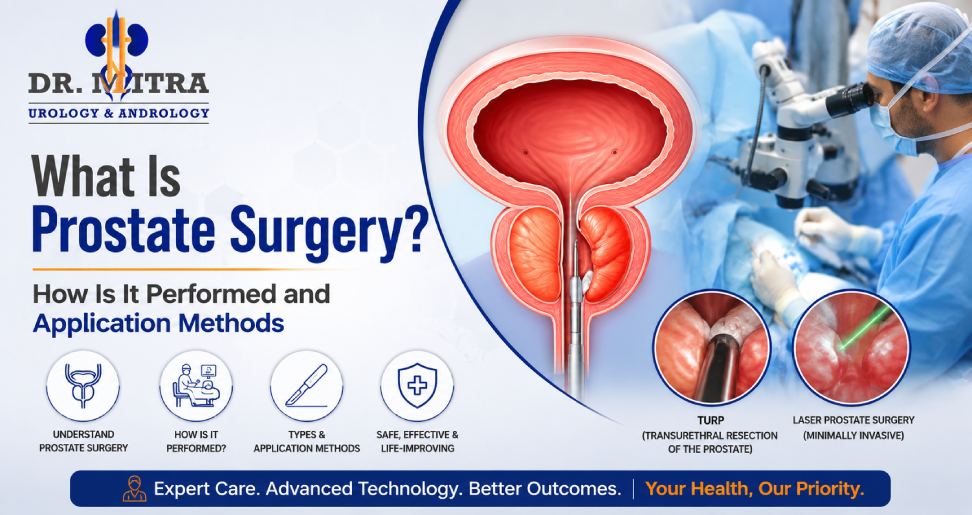
For prostate cancer, the operation is radical prostatectomy. We take out the entire prostate gland, the seminal vesicles, surrounding tissue. Where staging indicates it, some lymph nodes too. We’re removing the source of the cancer before it has the chance to spread further.
For an enlarged prostate, which is a completely different situation and not cancer, the surgery looks nothing like that. TURP goes through the urethra. No cuts in the abdomen. No external incision. We remove the tissue that’s blocking urine flow using an electrical loop. Laser procedures like HoLEP do the same job with a laser instead. Faster recovery, often more complete tissue removal.
Same organand very different problems, very different operations. We assess each patient individually before recommending anything.
Is Prostate Surgery a Serious Surgery?
Yes. We don’t soften this.
Radical prostatectomy is major surgery. The prostate is deep in the pelvis. Right next to it are the nerves that control erection. Just below it is the sphincter that controls urination. Operating in that space without disturbing what surrounds it is not simple. It requires a surgeon who does this regularly and knows that anatomy well.
TURP and laser procedures are far less invasive. But they still need anaesthesia. They still have a recovery period. Patients who treat them like a minor inconvenience and go straight back to normal activity often end up back in our office.
We tell patients what they’re undertaking. Proper preparation leads to proper recovery.
How We Actually Perform These Procedures
For radical prostatectomy, we use robotic-assisted laparoscopic technique for most patients. Small incisions, robotic instruments, a camera giving us a magnified view of the entire surgical field in three dimensions. Our movements get translated into precise instrument movements inside the body with the tremor filtered out. This matters when we’re working millimetres from structures we need to preserve.
Two to three hours in theatre. Home in one to two days. Catheter in for one to two weeks while everything heals inside.
Open surgery is still right for specific complex cases. Longer in hospital, longer recovery, same cancer outcomes.
For TURP, we go through the urethra. No skin incisions at all. We remove obstructing tissue with an electrical loop. In and out in one to two days for most patients.
HoLEP we use increasingly for larger prostates where we want more complete tissue removal. Faster return to normal urination. Good results in our patients.
What Happens After the Prostate Comes Out
We go through this in detail with every patient before surgery. Not after. Before.
Ejaculation stops. The seminal vesicles go with the prostate. Orgasm still happens but nothing comes out. This also means permanent infertility. Men who still want children need sperm banking done before the surgery date.
Urinary leakage is common in the first weeks. Most of our patients regain full continence over weeks to months with pelvic floor rehabilitation. A small number take longer. We support them through that.
Erections are affected. How much depends on whether we could spare the nerves, and on the patient’s age and baseline function. We start penile rehabilitation early after surgery, not at the six-month mark when men finally bring it up. Early is better. We say this clearly at every pre-operative consultation.
PSA after successful surgery should be undetectable. We check it at every follow-up. A rise in PSA is something we want to know about and act on early.
Can You Live a Normal Life Without a Prostate?
Most of our patients do that’s not reassurance. That’s what we see.
The first three to six months are an adjustment. Continence returning, waiting on erectile function, getting used to the changes in sexual function. It is not easy and we don’t tell patients it will be.
A year out, most of the men we operated on are back to their normal lives. Working, active, in their relationships. The prostate is not an organ the body fundamentally cannot function without. Recovery is the hard part. Long-term, most men are fine.
What We Tell Every Patient to Do
Pelvic floor exercises, starting four to six weeks before surgery. Not after. We see the difference in continence recovery between patients who do this and patients who don’t. The difference is real.
Ask us about nerve-sparing before the day. Whether we can spare the nerves depends on where the tumour sits. It affects erectile recovery. Know the answer before you go under.
Keep every follow-up appointment. PSA monitoring is not a formality. It is how we catch anything early enough to act on it.
What Our Patients Ask
Ans :- Radical prostatectomy, yes. Major surgery in a complex part of the body. TURP and laser procedures are far less invasive but still need proper preparation and recovery.
Ans :- Ejaculation stops permanently. Urinary continence and erections are affected and recover over months with rehabilitation. PSA drops to undetectable and we monitor it closely.
Ans :- Yes. Most of our patients do within a year. The recovery period is the challenge. The long-term outcome for most men is a normal life.
The Men Who Come Through This Best
They’re not the ones with the simplest cases. They’re the ones who came in prepared, started their pelvic floor work early, asked the right questions before surgery, and kept showing up for follow-up.
Dr. Nilanjan Mitra performs robotic radical prostatectomy, TURP, and HoLEP with full pre-operative preparation and post-operative follow-up for every patient. If prostate surgery is on the table, come and talk to us before a decision gets made.