What we see when a patient first sits down after a prostate cancer diagnosis, they are in fear and underneath it, a list of questions they don’t know how to ask.
What exactly is this surgery? How long does it take? What happens to normal life afterward? And the one sitting quietly behind all the others: am going to be okay?
We have this conversation constantly. And the single most useful thing we do in that first consultation is slow everything down and explain what happens, step by step, before a single decision gets made.
What Is a Radical Prostatectomy
We remove the entire prostate gland. In most cases we also take the seminal vesicles and surrounding tissue, and depending on staging, some nearby lymph nodes.
The goal is straightforward. Remove all the cancerous tissue before it spreads beyond the prostate. For localised prostate cancer, radical prostatectomy is one of the most reliable treatments we have. Long-term cancer control is strong when the procedure is done at the right time on the right patient.
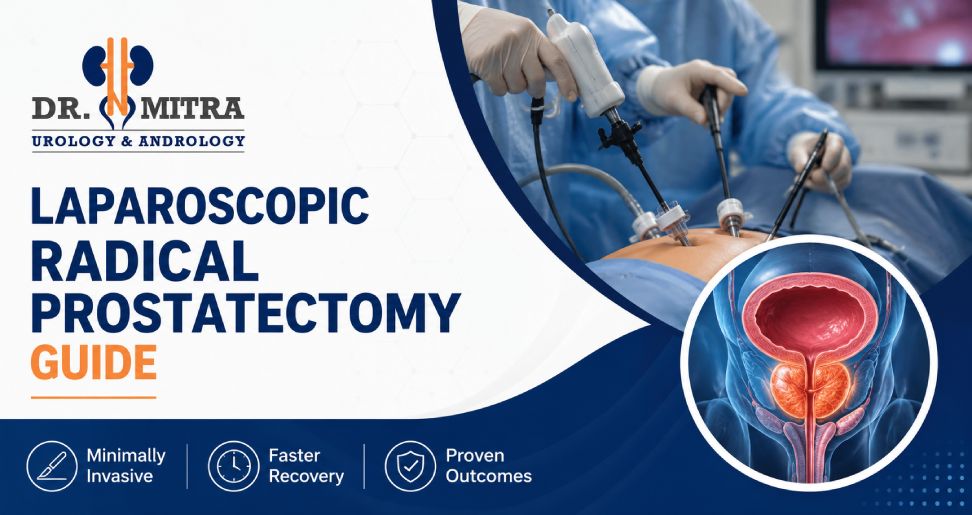
We perform laparoscopic radical prostatectomy rather than open surgery for most patients. Open surgery means a large abdominal incision. Laparoscopic means several small ones, a camera inside the body, and instruments that let us work with precision through those small entry points. Less blood loss, shorter hospital stays, faster recovery. The outcomes for cancer control are equivalent. The recovery experience is genuinely different.
Where anatomy and case complexity allow, we use robotic assistance for even greater precision and control. We discuss which approach fits each patient specifically at the pre-operative consultation.
How Long the Procedure Takes
Two to four hours is what we tell patients for most cases.
The actual time depends on the patient’s anatomy, body type, whether we’re doing lymph node dissection, and what we find once we’re inside. We set expectations clearly before the day, so nothing is a surprise.
Hospital stay after laparoscopic radical prostatectomy is one to two nights for most of our patients. Open surgery keeps men in hospital three to five days. That difference matters for how quickly recovery begins.
The catheter stays in for one to two weeks after we operate. We show patients and their families how to manage it before discharge. It’s manageable. Most patients adapt faster than they expect.
What Recovery Looks Like Week by Week
Week one is rest. We want patients moving around at home but nothing more than that. The body needs time.
Week two, movement improves. The catheter usually comes out at the end of this week. Some patients feel dramatically better once it’s gone. Others need a few more days to find their rhythm.
Weeks three and four, we encourage walking. Light daily movement helps recovery. Driving returns around this point for most, depending on comfort and whether the patient is still on pain medication.
Six weeks is when we typically see desk-based workers return to their jobs. Physical work takes longer, eight to twelve weeks usually.
We tell every patient clearly before surgery that continence and erectile function recovery takes months. Not weeks. This is the piece that catches men off guard most often when we haven’t had the conversation early enough. We have it early every time.
What Is Life Expectancy After a Radical Prostatectomy
This is the question underneath every other question we get asked.
For localised prostate cancer treated at the right stage, fifteen-year survival outcomes are strong. Many of our patients with low and intermediate-risk disease go on to live out a completely normal lifespan without recurrence.
What we monitor closely after surgery is PSA. Undetectable PSA after radical prostatectomy is what we’re looking for. Rising PSA can signal recurrence, and we want to catch that early if it happens. Regular follow-up appointments are not optional. They’re how good outcomes stay good.
The specific outlook depends on cancer grade, staging, whether surgical margins were clear, and how PSA behaves in the months after. We discuss this individually with every patient.
Preoperative Care Checklist
Start pelvic floor exercises now. Not after the surgery. Before. Men who come to us having already been doing Kegel exercises for four to six weeks before the procedure consistently show better continence recovery. We tell every patient this and we mean it.
Stop smoking as early as possible before the date. It affects anaesthetic response and wound healing in ways that are both documented and avoidable.
Get blood pressure and any managed conditions stabilised before the surgery date. Stability going in matters to how the procedure goes and how recovery begins.
Ask us specifically about nerve-sparing. Whether we can spare the nerves responsible for erection depends on tumour location. The answer affects erectile recovery. It’s a conversation worth having before the day, not after.
What Our Patients Ask Us
Ans :- Surgical removal of the entire prostate. We do it laparoscopically through small incisions with a camera and precision instruments. Shorter recovery than open surgery. Same cancer control outcomes.
Ans :- Two to four hours in our operating theatre for most cases. One to two nights in hospital. Catheter for one to two weeks after.
Ans :- For localised disease at the right stage, long-term survival is strong. We monitor PSA closely afterward and act early if anything changes. Outcomes are best when follow-up is consistent.
The Patients Who Come Through This Best
They’re not the ones with the simplest cases. They’re the ones who came in informed, asked the right questions, did the pelvic floor work before surgery, kept every follow-up appointment, and had a surgical team that communicated clearly through every stage.
Dr. Nilanjan Mitra performs laparoscopic radical prostatectomy with nerve-sparing technique where the case allows and follows patients through the full arc of recovery after surgery. If prostate cancer has been diagnosed and surgery is being considered that first consultation is where the decisions that matter get made.