Discovering a kidney tumour on an ultrasound or CT scan can be frightening. Many patients immediately wonder whether the tumour is cancerous, whether surgery is necessary, and whether they can live normally afterwards. The good news is that several kidney tumours can be treated successfully, particularly when detected before spreading.
For patients exploring kidney tumor surgery in Kolkata, understanding laparoscopic nephrectomy, kidney-preserving procedures, and recovery can make the next steps less overwhelming. This guide explains the treatment process and answers common questions in straightforward language.
What Is a Kidney Tumour?
A kidney tumour is an abnormal growth of cells within the kidney. Some tumours are benign, meaning they are not cancerous, while others are malignant and may develop into kidney cancer. Imaging tests help doctors assess a tumour’s size, location, and appearance, although additional investigations may be needed for diagnosis.
Kidney tumours do not always cause noticeable symptoms. Some are discovered incidentally during scans performed for unrelated health concerns. Blood in the urine, persistent side pain, or an abdominal lump can occur, but these symptoms have other possible causes and require medical assessment.
Can a Tumour Be Removed From a Kidney?
Yes. Surgery can remove many kidney tumours, but the appropriate procedure depends on the individual diagnosis and tumour characteristics. Doctors generally consider two main surgical options.
1. Partial Nephrectomy: Removing the Tumour
Partial nephrectomy removes the tumour along with a small margin of surrounding tissue while preserving the remaining healthy kidney. It is often preferred for suitable, localised tumours because retaining kidney tissue helps maintain kidney function.
This approach can be particularly valuable for patients with reduced kidney function, a single functioning kidney, or tumours affecting both kidneys. However, not every tumour can be removed safely using this technique.
2. Radical Nephrectomy: Removing the Entire Kidney
Radical nephrectomy involves removing the affected kidney and surrounding tissues when clinically necessary. Doctors may recommend it when a tumour is large, complex, or positioned where kidney-preserving surgery would be unsafe or unsuitable.
The decision balances cancer control, surgical risks, and the function of the remaining kidney. Having one healthy kidney is often compatible with a normal life, although long-term monitoring remains important.
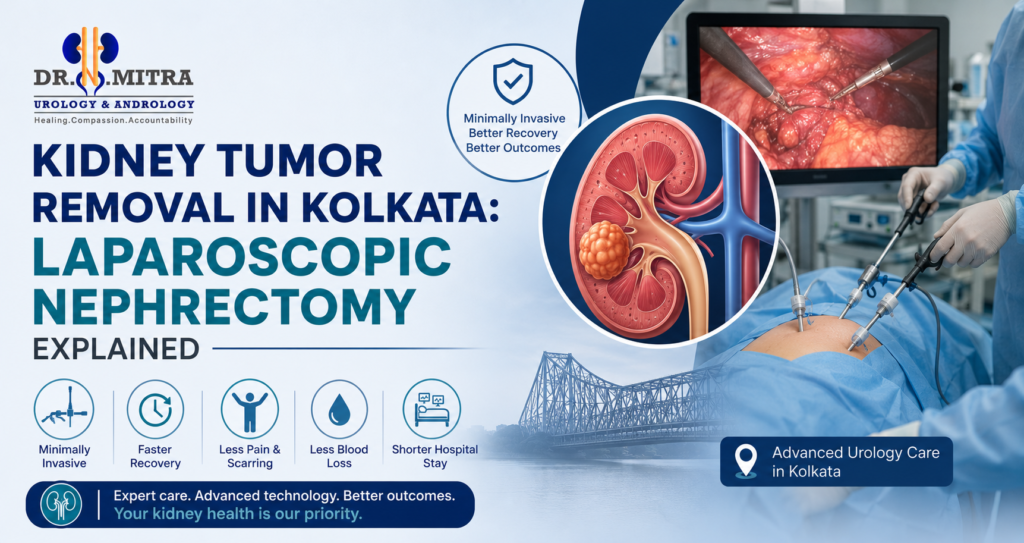
What Is Laparoscopic Nephrectomy?
Laparoscopic nephrectomy is a minimally invasive surgical technique. Instead of making one large incision, the surgeon creates several small openings through which a camera and specialised instruments are inserted.
The camera provides an internal view, allowing the surgeon to operate carefully around the kidney. Depending on the tumour and treatment plan, laparoscopy may be used for partial or radical nephrectomy.
Potential advantages include smaller incisions, reduced postoperative discomfort, shorter hospital stays, and a quicker return to everyday activities compared with traditional open surgery in appropriate patients. Results depend on tumour complexity, overall health, and the surgical team’s experience.
Importantly, minimally invasive surgery is not suitable for every case. The safest approach should be selected after reviewing imaging and clinical findings.
What Happens Before Kidney Tumour Surgery?
Preparation begins with a detailed consultation. Your doctor reviews symptoms, medical history, current medicines, previous operations, and any family history relevant to kidney disease or cancer.
Investigations may include blood tests to evaluate kidney function, urine tests, and imaging such as CT or MRI. These findings help determine tumour characteristics and whether cancer may have spread.
Ask your specialist whether a biopsy is appropriate, whether partial nephrectomy is possible, and how surgery may affect kidney function. Discuss anaesthesia, potential complications, expected recovery, and medication adjustments before admission.
Patients in Kolkata should also plan transport, postoperative assistance, and follow-up appointments before their procedure.
What Is the Success Rate of Kidney Tumour Surgery?
There is no single success rate that applies to every kidney tumour. Outcomes depend on whether the tumour is benign or malignant, its stage, size, biological behaviour, and whether it has spread beyond the kidney.
Localised kidney cancer can often be treated successfully with surgery. For appropriately selected patients, partial nephrectomy can provide cancer control comparable to removing the entire kidney while preserving more healthy tissue.
However, surgery cannot guarantee that cancer will never return. The final pathology report helps establish the diagnosis, tumour characteristics, and whether further treatment or surveillance is necessary.
Ask your specialist to explain the expected outcomes for your specific case rather than relying on general percentages found online.
Can a Kidney Tumour Be Cured?
Yes, some kidney tumours, including many cancers detected at an early stage, can be cured through appropriate treatment. Surgical removal may offer an excellent chance of long-term disease control when cancer remains localised.
If cancer has spread, treatment becomes more complex. Depending on the circumstances, doctors may consider medicines, immunotherapy, targeted therapies, surgery in selected cases, or a combination of treatments.
Regular follow-up remains essential even after apparently successful surgery. Your care team may recommend imaging and kidney-function tests to monitor recovery and identify possible recurrence.
Recovery After Laparoscopic Kidney Surgery
Recovery varies according to the operation performed, your general health, and whether complications develop. Patients may spend several days recovering in hospital, although the exact duration differs between individuals and procedures.
After discharge, follow your surgeon’s instructions regarding wound care, prescribed medicines, hydration, diet, and physical activity. Walking gently can support recovery, while strenuous exercise and heavy lifting should wait until your clinician confirms they are safe.
Attend every follow-up appointment. Seek prompt medical attention for fever, worsening abdominal pain, heavy bleeding, breathing difficulties, or markedly reduced urine output.
FAQs:
Is laparoscopic kidney surgery safer than open surgery?
It can offer recovery advantages for suitable patients, but safety depends on the tumour, individual health, and surgical expertise. Open surgery may be more appropriate in complex situations.
Will I need dialysis after kidney removal?
Not necessarily. Many people maintain adequate kidney function with one healthy kidney. However, the risk depends on existing kidney health and the function of the remaining kidney.
How do I choose kidney tumour treatment in Kolkata?
Choose a qualified urologist or uro-oncology team experienced in kidney tumour management. Review your scan findings, diagnosis, treatment alternatives, expected outcomes, and follow-up requirements before deciding.
Take the Next Step Towards Kidney Health
A kidney tumour diagnosis does not automatically mean losing an entire kidney or facing an uncertain outcome. Early evaluation can help identify appropriate treatment options and protect long-term kidney health.
If you are considering kidney tumor surgery in Kolkata, consult Dr. Nilanjan Mitra or a qualified urology specialist to discuss your reports and individual treatment needs. Informed decisions, appropriate surgery, and consistent follow-up can help you approach treatment with greater confidence.
Read More: